AgentForge: Building the Infrastructure Layer for Autonomous AI
A cloud-native runtime for defining, executing, orchestrating, observing, and scheduling production agent workloads.
View AgentForge on GitHub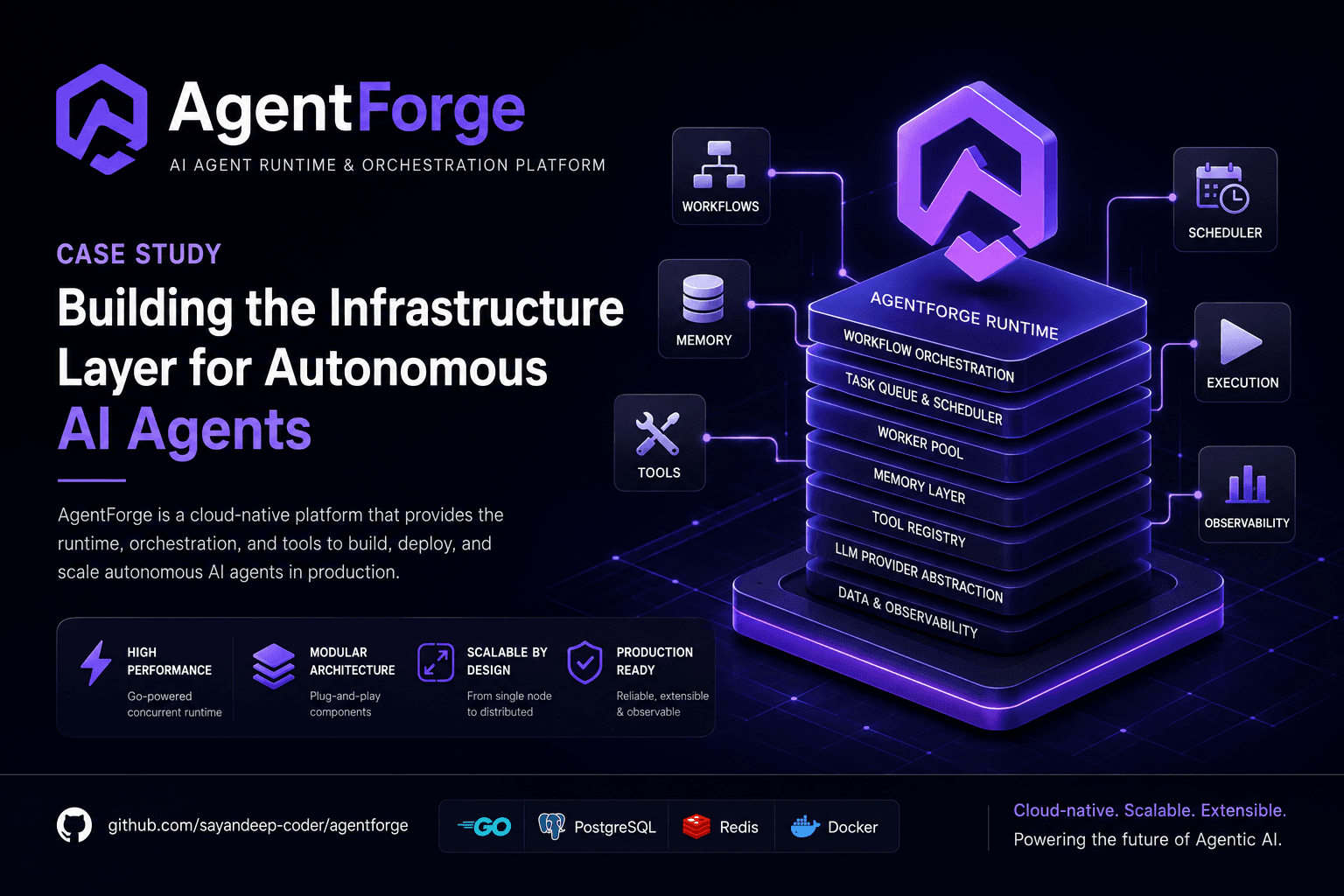
Overview
Agents need infrastructure, not just intelligence.
Building an agent demo can be straightforward. Operating that agent reliably is a distributed-systems problem involving durable task state, workflows, queues, workers, schedules, tools, memory, retries, and telemetry.
AgentForge addresses that operational layer. It is not a chatbot or another prompting framework; it is the backend execution system on which agentic products can be built.
The Problem
Every agent team rebuilds the same runtime.
As agent products move toward production, teams repeatedly implement execution loops, task queues, worker management, scheduling, memory, tool integration, retries, and long-running operations. These systems quickly become harder to maintain than the agent’s business logic.
The missing abstraction is a unified backend dedicated to the lifecycle of autonomous workloads—one that can begin as a focused service and grow toward distributed execution without forcing a rewrite.
The Goal
Let product teams own behavior, not runtime plumbing.
The platform isolates execution concerns behind stable interfaces. Developers define agents, tools, and workflow behavior while AgentForge manages persistence, dispatch, scheduling, worker execution, and operational state.
Platform Modules
Separate responsibilities. Composable execution.
Agent Runtime
Workflow Engine
Task Queue
Worker Pool
Scheduler
Tool Registry
Memory Layer
LLM Ports
Request Lifecycle
HTTP accepts the work. Workers own the execution.
A versioned REST endpoint validates the request and hands it to the application service layer. The service persists task state and publishes work to a queue. A worker claims that task, executes workflow steps, calls tools or an LLM provider, and records results and structured logs.
Clients observe status and results through the API, while cron schedules can create work independently. This keeps slow or failure-prone agent execution outside the HTTP request lifecycle.
Architecture
Domain logic does not depend on infrastructure.
AgentForge follows Clean Architecture and Domain-Driven Design. Domain and application packages do not depend on Gin, GORM, PostgreSQL, Redis, or a specific model vendor. Adapters implement contracts defined closer to the business logic.
Domain
Agents, workflows, tasks, schedules, and execution rules.
Application
Use cases, services, validation, and orchestration.
Infrastructure
HTTP, databases, queues, providers, and deployment.
That dependency direction makes business logic independently testable and lets infrastructure evolve without leaking vendor concerns through the platform.
Technical Decisions
Go for the execution plane
Goroutines, low runtime overhead, predictable deployment, and a strong backend ecosystem make Go a practical foundation for concurrent agent workloads.
PostgreSQL for durable truth
Agent metadata, workflow definitions, schedules, task state, execution history, memory, and logs belong in a transactional system of record.
Queues behind interfaces
The execution plane is decoupled from HTTP handlers, allowing queue implementations to evolve toward Redis or another broker without rewriting domain logic.
Infrastructure behind ports
LLM vendors, tools, repositories, queues, and memory stores are replaceable dependencies rather than assumptions embedded in the runtime.
Engineering Challenges
Designing today’s runtime around tomorrow’s pressure.
Workflow execution must support ordered steps and retries now while leaving room for branches and parallelism. Tool, model, queue, and memory implementations must remain extensible without turning every call path into generic framework code.
The central tradeoff was to build real production boundaries without prematurely implementing a distributed control plane. Stable interfaces provide the migration seams; the current system remains understandable and operable.
Current Implementation
A working foundation, not only an architecture proposal.
The repository includes typed configuration, structured logging, PostgreSQL and GORM access, schema-aligned models, repositories, services, an execution queue and worker runtime, tool and LLM ports, cron scheduling, middleware, migrations, and versioned REST endpoints.
Operable
Liveness, readiness, correlated logs, and graceful shutdown.
Replaceable
Repositories and providers remain behind narrow interfaces.
Durable
PostgreSQL persists execution state and domain records.
Potential Applications
Roadmap
From modular runtime to distributed agent platform.
Distributed worker clusters
Kubernetes-native deployment
Event-driven execution
Multi-agent collaboration
Vector memory
Human approval workflows
Real-time observability
MCP-native tools
Enterprise authentication
Plugin marketplace
Outcome
A reusable execution layer for intelligent systems.
AgentForge shows how agentic software can move beyond isolated model calls toward production platforms. Execution, orchestration, scheduling, memory, tools, and persistence become independent modules governed by the same engineering discipline used in modern distributed systems.
The long-term vision is infrastructure that lets teams build, deploy, and operate autonomous workloads without rebuilding the runtime beneath every product.
Explore the repository