Beyond LeetCode: Building a Pattern-First DSA Repository for Fun Learning
🔗 Repository Link: https://github.com/sayandeep-coder/DSA
Most Data Structures and Algorithms repositories follow the same formula.
A collection of hundreds of solutions.
Minimal explanations.
Little focus on why the solution works.
And almost no emphasis on pattern recognition.
While exploring DSA, I realized that real understanding doesn't come from memorizing solutions. The most enjoyable and effective way to learn is by recognizing patterns, reasoning through trade-offs, and adapting familiar ideas to new problems.
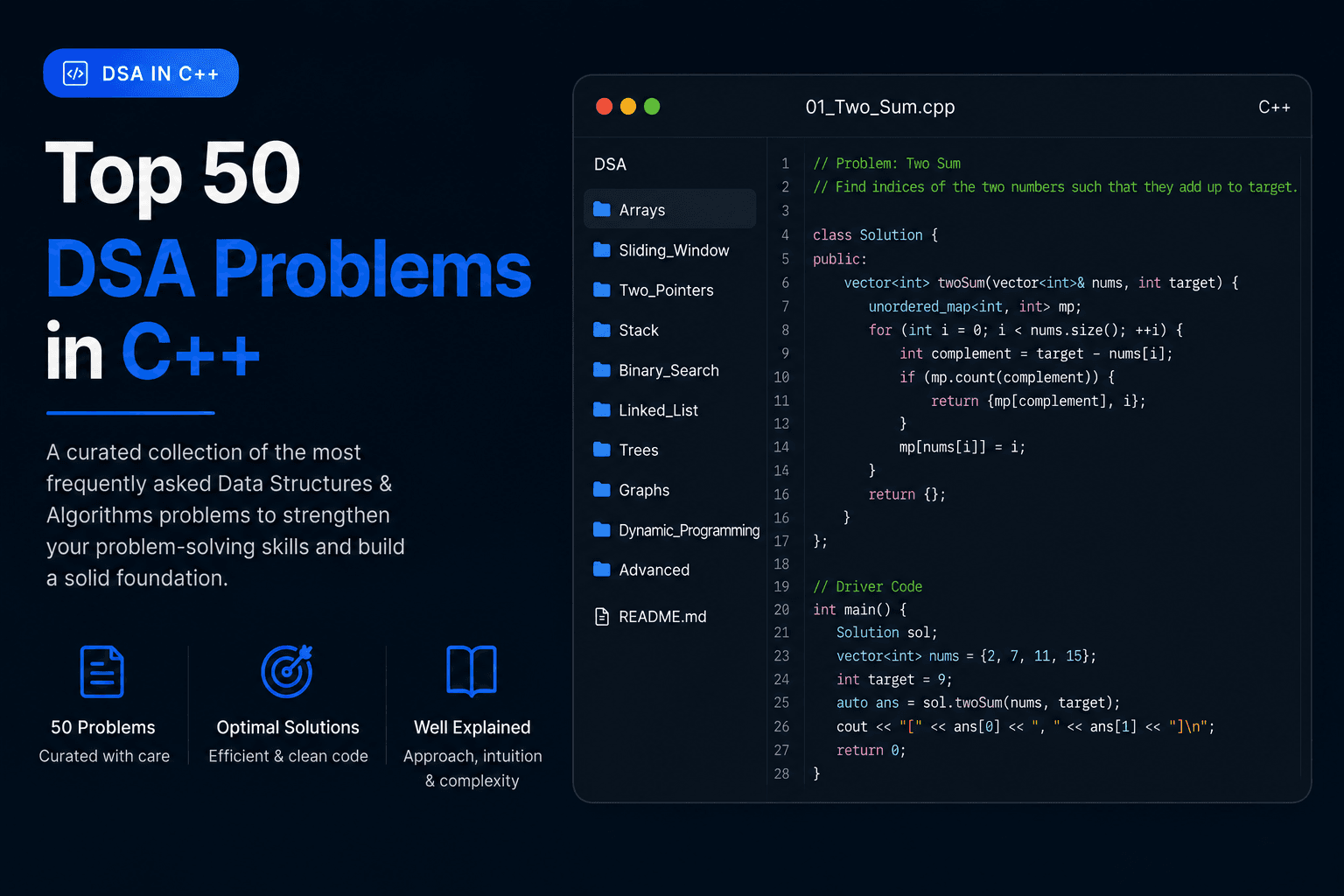
This realization led me to build a curated repository of 50 carefully selected problems.
The objective was not to create another collection of code snippets.
The objective was to create a structured and enjoyable learning system.
The Problem With Traditional DSA Practice
Many learners approach DSA in a repetitive way.
The common strategy is:
↓
Get Accepted
↓
Move To Next Problem
After solving dozens of problems, it often feels like progress is being made—but the deeper understanding is missing.
Why?
Because solving problems mechanically doesn't build intuition.
The real value comes from recognizing patterns and understanding how different techniques connect.
This changes how learning should be structured.
Designing A Pattern-First Repository
Instead of organizing problems randomly, the repository groups problems by the primary technique required to solve them optimally.
Examples include:
Sliding Window
Two Pointers
Stack
Binary Search
Linked Lists
Trees
Graphs
Dynamic Programming
This organization encourages thinking in terms of patterns rather than isolated questions.
When approaching a new problem, the first question becomes:
"Which pattern applies here?"
Not:
"Have I seen this exact question before?"
Why Only 50 Problems?
Many repositories contain hundreds or thousands of questions.
More content does not necessarily create better learning.
A large number of problems are variations of a relatively small set of core patterns.
The goal was to identify the highest-leverage problems.
Problems that teach concepts transferable across many scenarios.
Examples:
Two Sum
Teaches:
- Hash Maps
- Lookup Optimization
- Time vs Space Tradeoffs
Longest Substring Without Repeating Characters
Teaches:
- Sliding Window
- Dynamic Window Expansion
- Frequency Tracking
Course Schedule
Teaches:
- Graph Traversal
- Cycle Detection
- Topological Sorting
One problem often introduces concepts used across dozens of related questions.
Repository Architecture
The repository follows a predictable structure.
Each directory focuses on a specific pattern category.
This creates a learning progression that feels intentional rather than overwhelming.
Standardizing Every Solution
One common issue with algorithm repositories is inconsistency.
Different files often follow different styles.
Different levels of explanation.
Different coding conventions.
To solve this, every solution follows the same template.
Each file includes:
Difficulty
Pattern
Intuition
Approach
Complexity Analysis
Implementation
Example Execution
This consistency makes the repository easier to navigate and review.
Modern C++ As A Design Choice
The repository uses C++17 throughout.
The decision was intentional.
Modern C++ provides:
- Performance
- Rich STL Support
- Expressive Data Structures
Examples include:
priority_queue
vector
queue
stack
set
These abstractions allow solutions to focus on algorithmic reasoning rather than implementation details.
Building For Understanding, Not Acceptance
A common mistake during practice is optimizing for accepted submissions.
The better goal is understanding.
For every solution I attempted to answer:
Why does this approach work?
Why is it optimal?
What alternative approaches exist?
What tradeoffs are involved?
Understanding these questions builds deeper intuition than simply writing code that works.
The Core Patterns Covered
The repository focuses on the most essential patterns in DSA.
Arrays & Hashing
Common Skills:
- Lookup Optimization
- Frequency Counting
- Prefix Computations
Representative Problems:
- Two Sum
- Contains Duplicate
- Product of Array Except Self
Sliding Window
Common Skills:
- Dynamic Ranges
- Frequency Tracking
- Substring Analysis
Representative Problems:
- Minimum Window Substring
- Longest Substring Without Repeating Characters
Trees
Common Skills:
- DFS
- BFS
- Recursion
- Traversal
Representative Problems:
- Validate BST
- Maximum Depth
- Level Order Traversal
Graphs
Common Skills:
- Connectivity
- Traversal
- Topological Sorting
Representative Problems:
- Number of Islands
- Course Schedule
- Clone Graph
Dynamic Programming
Common Skills:
- State Representation
- Optimal Substructure
- Memoization
Representative Problems:
- Coin Change
- House Robber
- Longest Increasing Subsequence
Measuring Progress
Progress isn't about solving hundreds of problems.
It's about developing the ability to:
- Identify patterns quickly.
- Understand tradeoffs clearly.
- Build solutions step by step.
- Explain reasoning with clarity.
The repository was designed around these goals.
Not around maximizing problem count.
Lessons Learned
Building this repository reinforced a simple idea.
The best way to learn is not by memorizing solutions.
It's by recognizing patterns.
Whether working on algorithms, systems, or real-world applications, problem-solving often comes down to identifying recurring ideas and applying them effectively.
The objective is not solving every problem.
The objective is learning how to think.
Final Thoughts
Data Structures and Algorithms are a powerful way to develop problem-solving skills.
Not because every concept is used daily.
But because they teach structured thinking, tradeoff analysis, and systematic reasoning.
This repository represents an attempt to make that learning process more enjoyable and intentional.
Less memorization.
More understanding.
Less quantity.
More depth.
Because in learning, pattern recognition always beats pattern memorization.