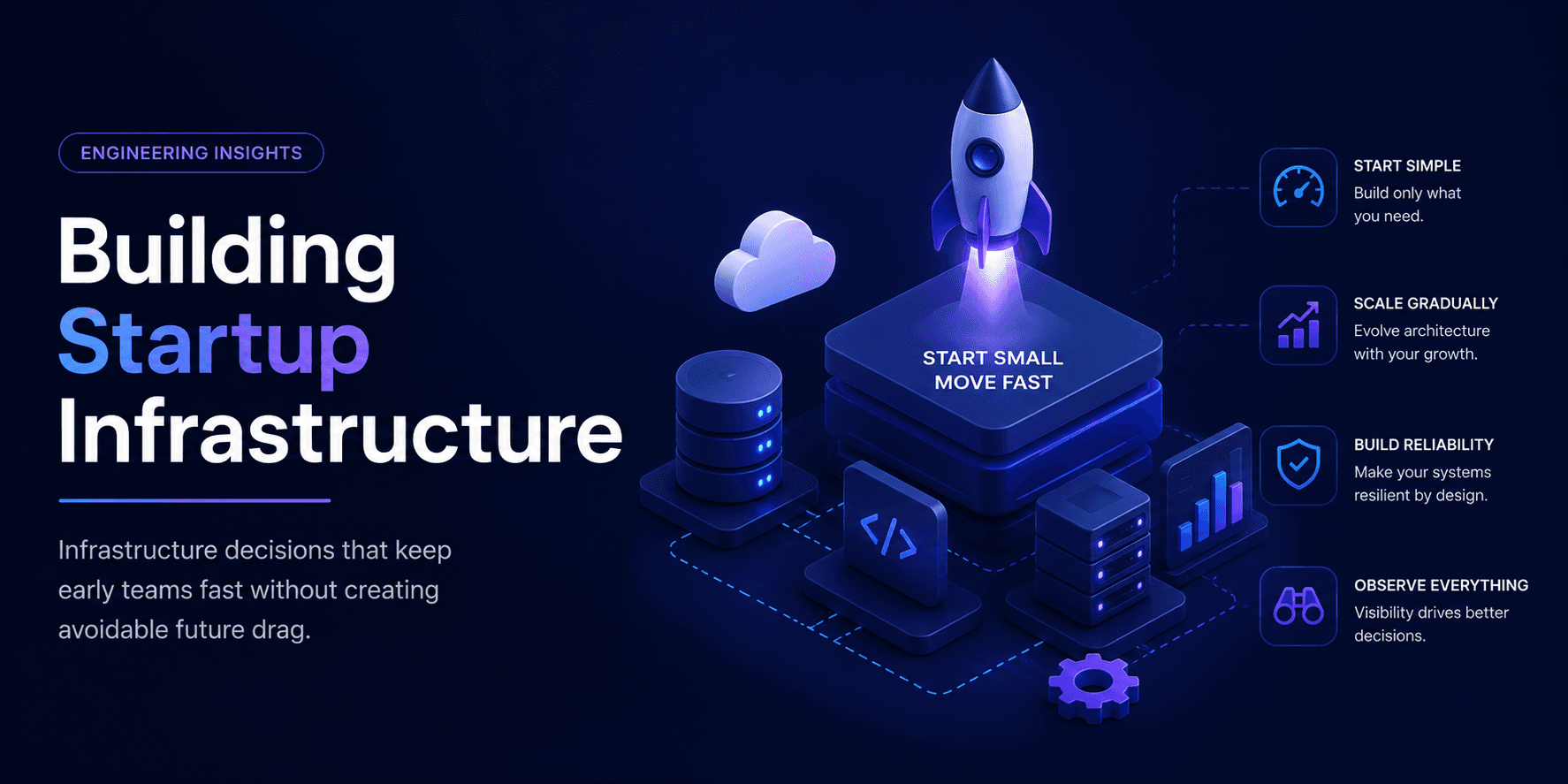
Building Startup Infrastructure: Scaling Without Slowing Down
Most startups don't fail because of infrastructure.
They fail because they never find product-market fit.
Yet infrastructure decisions can quietly determine whether a team moves fast, scales efficiently, or spends months fighting technical debt.
The challenge for every early-stage startup is balancing two competing priorities:
- Move as fast as possible.
- Avoid creating problems that become impossible to solve later.
Many teams get this wrong.
Some over-engineer from day one.
Others ignore infrastructure entirely until production systems begin breaking.
The goal is not building infrastructure for millions of users.
The goal is building infrastructure that supports today's growth while preparing for tomorrow's scale.
The Infrastructure Trap
Founders and engineers often fall into one of two extremes.
The Over-Engineering Trap
The team launches with:
- Kubernetes
- Service Mesh
- Event Streaming
- Multi-region deployments
- 20 microservices
Before acquiring their first 100 users.
The architecture is impressive.
The product is unfinished.
Complexity grows faster than customer value.
The Under-Investing Trap
The opposite extreme is equally dangerous.
Everything lives inside:
Frontend
  ↓
Backend
  ↓
Database
No monitoring.
No backups.
No queues.
No observability.
Everything works until growth arrives.
Then every deployment becomes risky.
Both approaches create problems.
The objective is progressive infrastructure.
Build what you need when you need it.
Infrastructure Should Follow Business Growth
Infrastructure is not the product.
Infrastructure exists to support the product.
A startup should evolve its architecture in stages.
Stage 1: Product Validation
The first goal is learning.
Not scaling.
Not optimization.
Not architectural perfection.
The startup needs answers to questions such as:
- Do users want this?
- Will they return?
- Will they pay?
At this stage simplicity wins.
Recommended Architecture
Client Application
        ↓
Backend API
        ↓
PostgreSQL
        ↓
Object Storage
This architecture supports:
- Rapid development
- Fast iteration
- Low costs
- Simple debugging
Most startups can reach thousands of users using this model.
Infrastructure Priorities
Focus on:
- Product delivery
- User feedback
- Analytics
- Stability
Avoid:
- Premature microservices
- Multi-region complexity
- Distributed systems
The simplest architecture that solves today's problem is often the correct architecture.
Stage 2: Operational Growth
Eventually growth creates new challenges.
Examples:
- Slow API responses
- Long-running tasks
- Increasing traffic
- Background processing
This is where supporting infrastructure becomes valuable.
Introducing Redis
Caching reduces database load.
Instead of:
User Request
      ↓
Database
Use:
User Request
      ↓
Redis Cache
      ↓
Database
Benefits:
- Lower latency
- Reduced database pressure
- Better user experience
Introducing Queues
Not every task belongs inside an API request.
Examples:
- Sending emails
- Processing images
- Running automation
- Generating reports
These tasks should become background jobs.
Queue-Based Workflow
User Request
       ↓
API
       ↓
Queue
       ↓
Worker
       ↓
Task Execution
The user receives a response immediately.
Workers process the task asynchronously.
Introducing Monitoring
Many startups wait until something breaks before implementing monitoring.
This is a mistake.
Track:
- CPU
- Memory
- Errors
- Response Times
- Database Health
Visibility prevents surprises.
Stage 3: Scaling Operations
As products grow, responsibilities become more complex.
A single backend begins handling:
- Authentication
- Payments
- Notifications
- Analytics
- User management
Eventually one codebase becomes difficult to maintain.
Domain Separation
This is often the right moment to split systems.
Example:
Auth Service

User Service

Payment Service

Notification Service

Analytics Service
Each service owns a specific responsibility.
The goal is not microservices.
The goal is ownership.
Event-Driven Growth
As the number of systems increases, direct service communication becomes fragile.
Example:
Order Service
      ↓
Notification Service
      ↓
Analytics Service
Dependencies multiply.
Instead:
Order Created Event
       ↓
Queue
       ↓

Notification Consumer

Analytics Consumer

Reporting Consumer
Services become independent.
The platform becomes easier to evolve.
Infrastructure For AI Products
Modern startups increasingly include AI systems.
AI introduces unique infrastructure requirements.
Examples:
- Vector databases
- Background inference
- Agent orchestration
- Workflow execution
- Model observability
A typical AI platform may look like:
Client
  ↓
API Gateway
  ↓
AI Orchestrator
  ↓
Vector Search
  ↓
LLM Layer
  ↓
Business Services
The AI layer becomes another component of the platform rather than the platform itself.
Infrastructure For Automation Products
Automation systems require a different architecture.
Example:
User Request
      ↓
API
      ↓
Queue
      ↓
Worker Pool
      ↓
Browser Cluster
      ↓
External Platforms
This design enables:
- Reliability
- Retry handling
- Horizontal scaling
- Failure isolation
The queue becomes the foundation of execution.
The Importance Of Observability
As systems grow, visibility becomes critical.
Every startup should eventually monitor:
Infrastructure Metrics
- CPU
- Memory
- Network
Application Metrics
- API Latency
- Error Rates
- Request Volume
Business Metrics
- Orders
- Revenue
- Conversion Rate
- Retention
The most valuable metric is often not technical.
It is business impact.
Reliability Before Scale
Many teams optimize for scale too early.
A system handling:
10,000 Requests
Reliably is often more valuable than a system theoretically capable of:
10 Million Requests
Reliability creates trust.
Trust creates growth.
Growth creates scale.
Scale should follow demand.
Not assumptions.
Common Startup Infrastructure Mistakes
Building Microservices Too Early
A monolith is often the correct first architecture.
Ignoring Backups
Every production database should have automated backups.
No Monitoring
Problems become invisible.
No Queues
Background workloads block user requests.
Over-Optimizing
Optimization without traffic is wasted effort.
A Modern Startup Architecture
A practical architecture for many startups looks like:
Frontend
      ↓
API Gateway
      ↓
Core Services
      ↓
PostgreSQL

      ↓

Redis Cache

      ↓

Message Queue

      ↓

Workers

      ↓

Object Storage
Simple.
Scalable.
Maintainable.
Key Engineering Principles
Over the years, a few principles consistently prove valuable.
Optimize For Delivery
Shipping creates learning.
Learning creates product-market fit.
Build Incrementally
Architecture should evolve alongside the business.
Measure Everything
Data drives better decisions.
Automate Repetitive Work
Manual processes become bottlenecks.
Prioritize Reliability
Users remember downtime.
They rarely notice elegant architecture.
Final Thoughts
The best startup infrastructure is not the most complex.
It is the infrastructure that allows a small team to move quickly, learn rapidly, and scale confidently.
Infrastructure should accelerate product development.
Not become the product itself.
Great startups win because they build valuable products.
Great infrastructure simply makes that possible.
The most successful engineering teams understand this distinction.
They do not build for millions of users on day one.
They build systems that can evolve naturally as growth arrives.
And that is what sustainable startup infrastructure is really about.