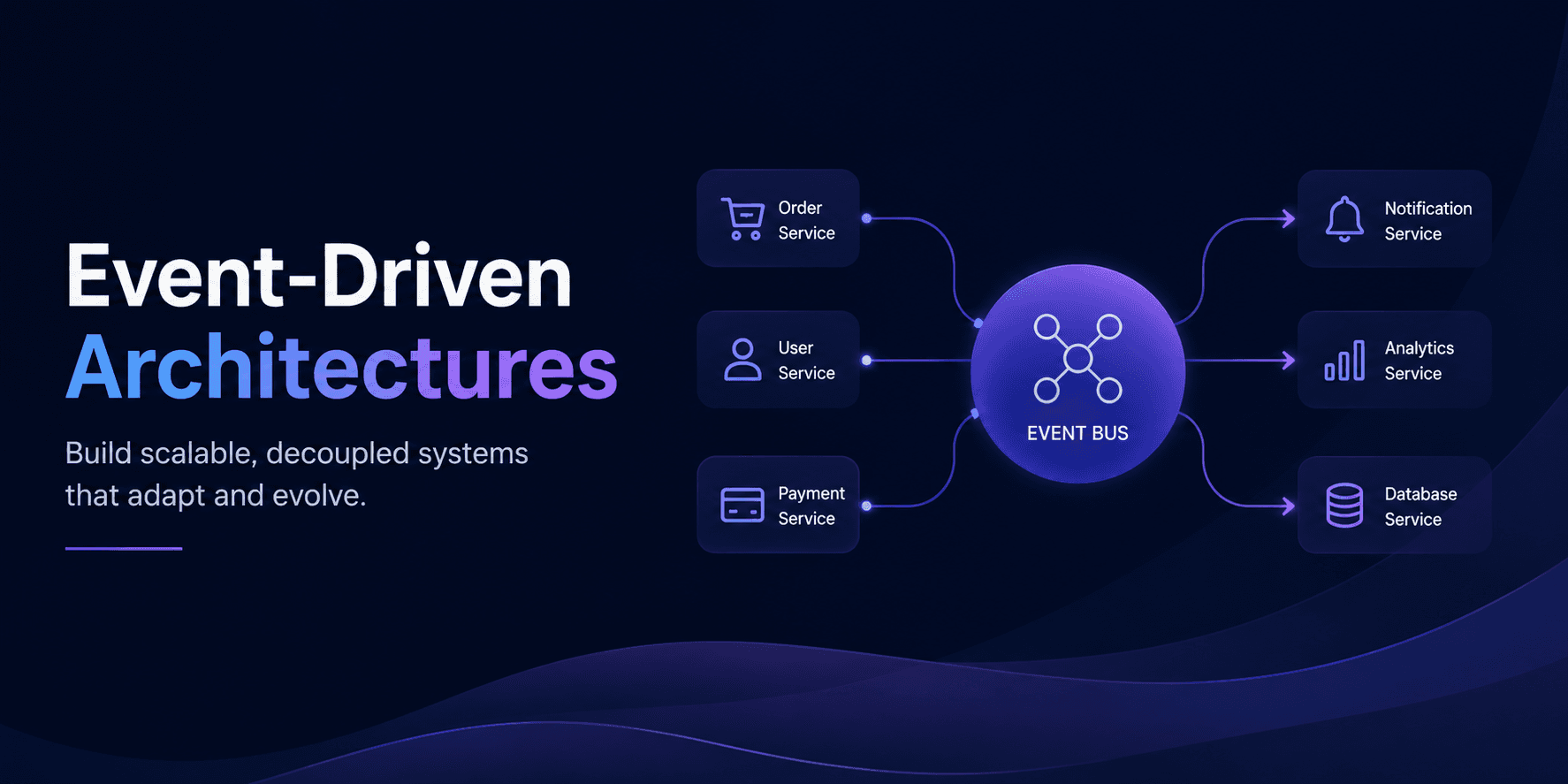
Event-Driven Architectures: Building Systems That Scale
As software systems grow, complexity grows with them.
The challenge is no longer building features.
The challenge becomes building systems that can evolve, scale, and adapt without becoming tightly coupled and increasingly difficult to maintain.
Most engineering teams eventually discover the same problem.
The architecture that worked perfectly for ten users becomes painful at ten thousand.
The architecture that worked for one team becomes fragile when ten teams contribute to the same product.
Growth introduces a new requirement.
Not more features.
Better coordination.
This is where event-driven architecture becomes important.
The Core Thesis
Stop thinking in terms of service calls.
Start thinking in terms of business events.
Traditional systems are built around requests.
Event-driven systems are built around facts.
This distinction fundamentally changes how software evolves.
A request asks another system to do something.
An event announces that something has already happened.
That difference creates one of the most powerful architectural patterns in modern software engineering.
The Problem With Direct Communication
Most systems begin with direct service communication.
The architecture is simple.
A user places an order.
The Order Service calls:
- Payment Service
- Notification Service
- Analytics Service
- Fulfillment Service
- Invoice Service
At small scale, this approach works perfectly.
Everything is straightforward.
Everything is easy to understand.
Everything feels connected.
Then the product grows.
New features appear.
More services are introduced.
Additional teams begin building on top of existing workflows.
Suddenly a single business action triggers dozens of dependencies.
What was once a simple workflow becomes a complex network of interconnected services.
The architecture becomes increasingly fragile.
The Dependency Problem
Imagine a customer places an order.
The Order Service now needs to:
- Process payment.
- Send notifications.
- Update analytics.
- Trigger fulfillment.
- Generate invoices.
- Update customer rewards.
- Trigger recommendation systems.
- Log business metrics.
- Publish audit records.
What initially looked like a single workflow is now coordinating multiple independent systems.
The problem becomes even worse when one dependency fails.
If Analytics Service experiences downtime, should order creation fail?
Of course not.
If Notification Service becomes unavailable, should the customer be prevented from purchasing?
Again, no.
Yet tightly coupled architectures often force these unrelated systems to depend on one another.
This is where scalability problems begin.
A Different Way Of Thinking
Event-driven architecture approaches the problem differently.
Instead of telling other services what to do, services simply announce what happened.
This distinction is critical.
The system stops issuing instructions.
The system starts publishing facts.
For example:
Instead of: "SendNotification"
The system publishes: "OrderCreated"
One is a command.
The other is a fact.
Commands create dependencies.
Facts create flexibility.
Events Represent Business Reality
An event represents something that has already occurred.
Examples include:
- UserRegistered
- OrderCreated
- PaymentCompleted
- SubscriptionRenewed
- RefundProcessed
- CartAbandoned
- ProductViewed
- PasswordChanged
Events are not requests.
They are historical records.
They describe reality.
This allows multiple systems to interpret and react to the same event independently.
Understanding The Shift
Consider a customer completing a purchase.
Traditional Architecture:
Order Service → Payment Service → Notification Service → Analytics Service → Fulfillment Service
Every dependency must succeed. Every dependency must respond. Every dependency introduces latency.
Event-Driven Approach:
Order Service → Publish OrderCreated → Multiple consumers react independently
The Order Service no longer cares who listens.
Its responsibility ends once the event is published.
This creates a clean separation between business actions and business reactions.
The Core Components
Every event-driven system is built around three fundamental components.
Event Producers
Producers generate events. A producer publishes an event when something meaningful occurs within the business domain.
The producer's responsibility ends after publishing the event. It does not care who consumes it.
Message Brokers
The message broker acts as the transportation layer.
Examples include RabbitMQ, Kafka, Amazon SQS, Google Pub/Sub, Azure Service Bus.
The broker separates producers from consumers.
Event Consumers
Consumers react to events. Different consumers can interpret the same event in different ways.
One Event, Many Outcomes
A powerful property of event-driven systems is leverage.
A single event can unlock multiple workflows simultaneously.
Imagine a payment succeeds. "PaymentCompleted" triggers Notifications, Analytics, Fraud Detection, Customer Rewards, Financial Reporting, and Recommendation Systems.
None of these systems need to know about one another. Each operates, evolves, and scales independently.
Why Event-Driven Systems Scale
The biggest benefit is not performance. The biggest benefit is decoupling.
Teams can deploy independently, scale independently, fail independently, and experiment independently.
Reliability Through Isolation
Modern systems must assume failure.
In tightly coupled architectures, failures often cascade. In event-driven architectures, failures remain isolated.
If Analytics Service crashes, orders can still be placed. The event remains in the broker until analytics recovers.
Independent Scaling
Not every service experiences the same workload.
Event-driven systems allow each consumer to scale according to its own needs. Resources are allocated where demand actually exists.
Event Replay
One of the most underrated advantages of event-driven systems is replayability.
Events create a historical record of business activity. When events are retained, new systems can replay historical events to reconstruct state.
Observability Through Business Events
Events provide something that traditional request-response architectures often struggle with: Business visibility.
Common Mistakes
Event Explosion
Not every action deserves an event. Publishing unnecessary events creates noise and complexity.
Poor Naming
Events should describe facts, not commands (e.g. OrderCreated, not ProcessOrder).
Missing Idempotency
Consumers may process the same event multiple times. Systems must safely handle duplicates.
Ignoring Monitoring
What cannot be observed cannot be improved.
Event-Driven Architectures In Modern Products
The pattern appears everywhere:
- Commerce Platforms: CartUpdated, OrderCreated, PaymentCompleted, RefundProcessed
- AI Platforms: PromptSubmitted, AgentExecuted, ResponseGenerated, EvaluationCompleted
- Logistics Platforms: OrderAssigned, DriverDispatched, DeliveryCompleted
- Inventory Platforms: StockUpdated, WarehouseReplenished, ProductPublished
Different industries. Same architectural pattern.
The Organizational Advantage
The biggest benefit of event-driven architecture is often organizational rather than technical.
As companies grow, coordination becomes expensive. Events create natural boundaries. Each team can move faster because fewer direct dependencies exist.
Final Thoughts
Businesses are collections of events.
Customers register. Orders are placed. Payments succeed. Subscriptions renew. Products are viewed. Refunds occur.
Reality itself is event-driven.
Software systems become easier to scale when they reflect that reality.
The goal of architecture is not eliminating complexity. Complexity is inevitable. The goal is managing complexity in a way that allows systems, teams, and products to evolve over time.
Event-driven architectures provide one of the most effective frameworks for achieving that goal.
As organizations grow, the most successful systems are rarely built around requests. They are built around events.